Why self-build?
Six reasons to build your own.
For the first time in a generation, the route is more open – and more beneficial – than it has been since the 1970s.
Planning policy is on your side.
For the first time in a generation, policy favours the self-builder. Local authorities are now obliged to maintain self-build registers and to grant permissions that meet their demand. Decision timelines have shortened. The shift from 'looking for a house' to 'looking for land' is now a credible mainstream path across the UK.
The financial case has shifted.
Self-build mortgages now lend up to 95% of land costs as well as up to 95% of build costs – opening the route to those with income and savings (not only substantial capital) at interest rates that can start from just 5%.
When your build is completed and signed off, the lender ports your mortgage into a standard residential mortgage at the lower applicable rate, often with no early-repayment charge. As stamp duty is also calculated on the plot value alone (not the finished home that comes later), the cumulative financial position is often decisively better than buying an existing house.
You build in equity from day one.
A properly structured self-build, on the right plot, should produce a finished home worth at least 10% more than the total of land cost and build cost. By contrast, buying an existing home means paying stamp duty and other fees that put you into negative equity the moment you move in. Self-build inverts that dynamic – you create value rather than absorb it.
Your home, your way.
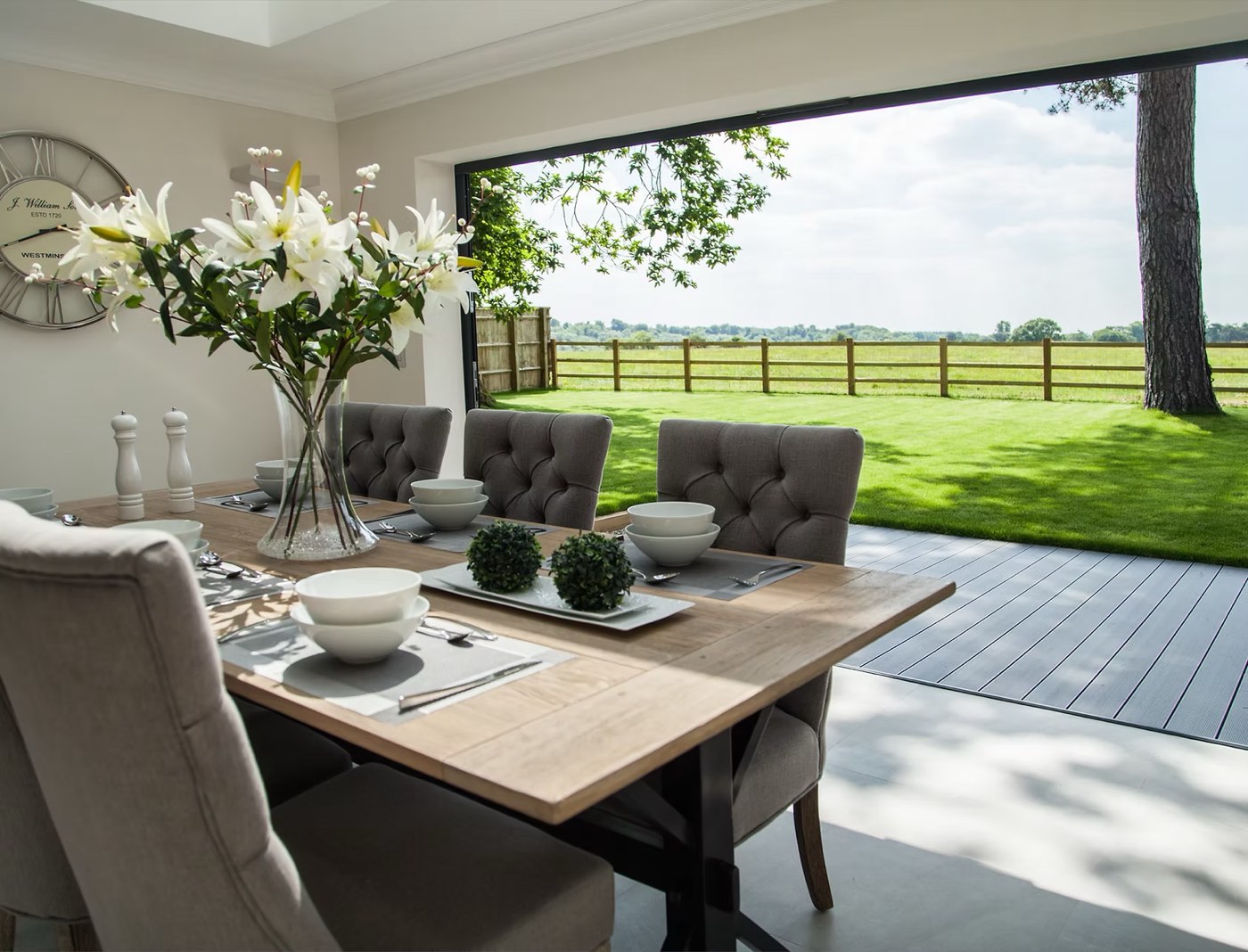
A dressing room large enough for two. A utility room with a dedicated drying space and an extractor that means clothes never hang in the kitchen again. A kitchen that opens fully to the garden. Every small decision that an existing home forces you to accept, you can make for yourself when building your own.
Future-proofing is built in.
A new build lets you consider the future from the ground up. Modern building regulations focus on energy efficiency and emerging standards, ensuring the right systems and technology are built in, with materials that will age well. Retrofitting an existing home to the same standard is technically difficult, structurally compromising, and often costs more than the equivalent specification at the design stage of a new home.
A sense of fulfilment.
A home you brought into being yourself – choosing the land, shaping the brief, watching it rise out of the ground – is an exercise in fulfilment. It is a significant commitment of energy and resources, but a well-organised self-build is among the most rewarding and creative undertakings open to an individual or a family.
Peace of mind
Self-building, de-risked.
Self-building is not the risk Grand Designs makes it out to be, if structured and approached professionally. Here's how we take away uncertainty.
What if I can't get planning?
We secure planning permission at our own cost and risk before you commit to buying the land – so you never buy a plot you can't build on.
What if it costs more than planned?
Budgets are set with a developer's cost-discipline and agreed before we start. You choose finishes against a known number, and we track every figure – including VAT owed back to you.
What if the build drags on?
We manage the entire programme to an agreed schedule, with the same trades and oversight we use on our own developments.
What if the finance won't stack up?
We introduce you to specialist self-build lenders, and in certain cases cover your interest-only payments through construction.
What if something's wrong at the end?
Every completed home carries a 10-year structural warranty – brand new, with nothing to fix on day one.
The detail
The numbers, side by side.
Four dimensions on which building compares with buying.
| Purchasing an existing property | Building your own | |
|---|---|---|
| Stamp duty | 100% Stamp duty is paid on the full value of the property at the point of purchase. |
~ 15% Stamp duty is paid only on the land's value before building – a fraction of the finished home's worth, and taxed at lower marginal rates. |
| Self-build can reduce the stamp duty payable to roughly a sixth of that on an equivalent finished home. | ||
| Equity at completion | Negative Transaction costs of 5–7% mean most buyers begin in negative equity the day they move in. |
+ 10% A well-structured self-build typically produces a home worth at least 10% more than land and build costs combined. |
| You create value rather than absorb it. | ||
| Financing | 10–25% Deposit typically required for a standard residential mortgage. |
From 5–10% Specialist self-build lenders now lend up to 95% of land costs and up to 95% of build costs. |
| A route now open to anyone with income and savings – not just the cash-rich. | ||
| Annual energy bills | ~ £2,000 Average annual running cost for older properties. |
~ £1,000 Modern self-builds typically halve running costs. During the 2022–23 energy crisis, new-builds saved over £2,000 per year on average (Home Builders Federation). |
| A recurring saving that compounds – and grows during periods of energy market stress. | ||